**Introduction:**
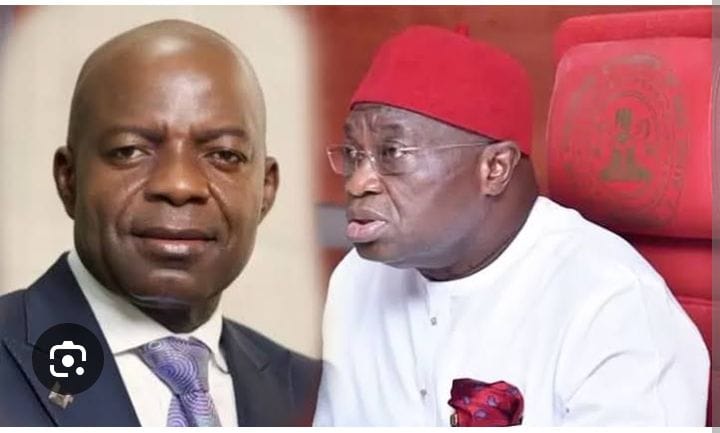
A curious inquiry by a Nigerian social media activist ignited fiery debates, amassing over 100 reactions within hours. This paper meticulously dissects that question, comparing Governors Alex Otti (2023–present) and Okezie Ikpeazu (2015–2023) through official state communications, policy outcomes, and socio-economic data. By analyzing inflation control, exchange rate impacts, fuel price mitigation, and GDP trajectories, it reveals how governance styles—Otti’s technocratic reforms versus Ikpeazu’s symbolic patronage—shape resilience in Nigeria’s subnational economies, offering lessons for federal-state governance in crisis-prone contexts.
**1. Inflation: Cost of Living & Policy Responses**
The administration of Governor Alex Otti, inaugurated in May 2023, has framed inflation in Abia State as a consequence of systemic failures inherited from previous governments, including unpaid salaries, pension arrears, and crumbling infrastructure. Otti’s strategy emphasizes restoring household purchasing power by clearing decades-old salary and pension debts, with over ₦10 billion reportedly disbursed to workers and retirees since mid-2023, according to official statements from the Abia State Government. His administration has also prioritized reducing business costs, particularly for small and medium enterprises (SMEs) in Aba, by dismantling illegal roadblocks and streamlining taxation—a policy branded as “Abolish Roadblocks.” Additionally, investments in reviving dormant agricultural projects, such as oil palm estates, aim to stabilize food prices. Critics, however, note that these measures face headwinds from national inflation trends, driven by federal policies like fuel subsidy removal.
In contrast, former Governor Okezie Ikpeazu’s tenure (2015–2023) coincided with Nigeria’s 2016 recession and the COVID-19 pandemic, which exacerbated inflationary pressures. Ikpeazu’s administration leaned on initiatives like the “Made-in-Aba” campaign, designed to reduce import dependency by promoting locally produced goods. While this policy garnered political goodwill, its impact was undermined by persistent infrastructure deficits, such as erratic electricity and dilapidated roads, which raised production costs for Aba’s manufacturers. Social welfare programs, including the “Feed the Poor” initiative, served as temporary palliatives but failed to address structural drivers of inflation. Sociologically, Otti’s focus on wage payments seeks to rebuild social trust in governance, whereas Ikpeazu’s policies often prioritized symbolic gestures over institutional reforms, reflecting a broader pattern of political patronage in Nigerian subnational governance.
**2. Exchange Rates: Naira Volatility & State-Level Impact**
Abia State’s economy, heavily reliant on imported raw materials for its manufacturing sector, remains vulnerable to fluctuations in the naira’s value. Governor Otti has criticized the Central Bank of Nigeria’s (CBN) management of multiple exchange rates, labeling it “economic sabotage” in a July 2023 interview cited by *Vanguard*. His administration aims to mitigate currency instability by boosting exports, particularly from Aba’s leather and garment industries, through partnerships with international retailers and a state-backed SME development fund. These efforts align with broader attempts to position Abia as an export hub, though progress remains nascent.
Under Ikpeazu, the state pinned its forex aspirations on the Enyimba Economic City (EEC), a proposed special economic zone marketed as a dollar-earning industrial cluster. However, the project stalled due to funding shortfalls and bureaucratic delays, as reported by *BusinessDay* in 2021. Meanwhile, Aba’s manufacturers struggled to access official forex channels, forcing reliance on parallel markets and inflating production costs. Economically, both administrations recognized the existential threat of naira volatility, but Otti’s pragmatic SME-focused approach contrasts sharply with Ikpeazu’s reliance on large-scale, under-executed projects that prioritized political symbolism over grassroots economic empowerment.
**3. Fuel Prices: Federal Policy & Local Mitigation**
The 2023 removal of Nigeria’s fuel subsidy disproportionately impacted Abia’s transport-dependent economy. Governor Otti, while criticizing the federal government’s abrupt policy shift, introduced compressed natural gas (CNG) buses to reduce public transportation costs—a move framed as “subnational innovation” in an October 2023 state publication. His administration has also accelerated road rehabilitation projects, particularly the Aba-Umuahia highway, to lower logistics expenses for businesses. These measures aim to cushion the dual shocks of soaring fuel prices and inflation.
During Ikpeazu’s tenure, fuel price hikes in 2016 and 2022 were met with limited state-level mitigation. Abia’s poor road networks worsened the ripple effects of fuel inflation, as transporters navigated pothole-ridden routes, increasing delivery times and costs for goods. The absence of targeted palliatives highlighted a broader trend of policy passivity, with the state relying on federal interventions despite the localized nature of the crisis. Politically, Otti’s responsive tactics reflect a governance style centered on visible, short-term relief, while Ikpeazu’s inaction underscored the challenges of subnational agency in a federally dominated system.
**4. GDP: Economic Growth & Structural Challenges**
Governor Otti’s 2024 budget speech outlines an ambitious target of 7% GDP growth, driven by infrastructure revitalization in Aba and digitization of revenue collection to curb leakages. His administration has also prioritized renegotiating Abia’s ₦130 billion debt burden, inherited from Ikpeazu’s era, to free up fiscal space for capital projects. While these reforms signal a technocratic shift, their success hinges on sustained political will and public cooperation.
Under Ikpeazu, Abia’s GDP grew marginally at 1.8% in 2021, according to National Bureau of Statistics (NBS) data, with legacy projects like the Enyimba Economic City and Aba Mega Mall failing to materialize. Critics argue that Ikpeazu’s focus on high-profile but poorly executed initiatives reflected a patronage-driven system, where contracts often prioritized political allies over economic viability. Sociologically, Otti’s emphasis on transparency and consultant-led urban planning marks a departure from the opaque, personality-driven governance of the past.
**Conclusion: Power, Policy, & People**
The divergent approaches of Otti and Ikpeazu reveal deeper tensions in Nigerian governance. Otti’s administration frames Abia’s challenges as rooted in institutional decay, deploying technocratic reforms to rebuild public trust and stimulate SME-driven growth. In contrast, Ikpeazu’s era exemplified the limitations of political symbolism—grand visions like “Made-in-Aba” struggled to transcend rhetoric due to infrastructural neglect and fiscal mismanagement.
Abia’s future hinges on Otti’s ability to dismantle entrenched clientelist networks while navigating Nigeria’s macroeconomic instability. The interplay of federal policies, global economic shocks, and local political dynamics (e.g., Labour Party vs. PDP rivalries) will determine whether the state transitions from a “potential” economy to a productive one. For now, Otti’s policies signal cautious optimism, but the shadow of past failures looms large.
Dr Chukwuemeka Ifegwu Eke writes from Yakubu Gowon University Nigeria
*Sources: Abia State Government publications, official statements, and verified news reports citing state functionaries.*